Intel, Asus, Cooler Master, Corsair Memory, Dell, Compaq, Gigabyte, Mercury, zebronics, AMD, Nexus, Delta, IBM, HP, Apple, Acer, BenQ, Sony, Samsung, LG, Philips, Transcend, Nvidia, SiS, Logitech, Alps Electric Corporation, Creative Technology, ASRock, Asus

Blog Archive

Showing posts with label Enables. Show all posts

Monday, 6 February 2012

Motorola Droid RAZR, RAZR MAXX Update Enables CDRX for Better LTE Battery Life

While we don't usually cover every software update on every platform, I thought it worth noting something special about the new update which will begin going out shortly to the Motorola Droid RAZR and RAZR MAXX. Among the features included in "6.12.173.XT912.Verizon.en.US" is a new feature that isn't directly advertised in the changelog - it's the inclusion of Connected Discontinuous Reception, or CDRX for Motorola/TI's codename Wrigley 4G LTE baseband. The short of it is improved battery life on 4G LTE.

Discontinuous Reception (DRX) is nothing new for UMTS based networks, and is a power reduction feature. The aim is simple - during idle periods, the cellular network tells the handset that it doesn't need to expect any traffic, and thus the handset can shut down the RF frontend and other power draining bits. The phone can then wake up the parts required to receive and listen to a paging channel when the discontinuous cycle ends. 

The above is the way things work in UMTS, in 4G LTE things change a bit, but the concept is the same. However a new feature is the somewhat strangely-named connected DRX mode. The "connected" part comes from the fact that DRX now can work while the user equipment is in an RRC_Connected state, in addition to RRC_Idle. The result is that the handset can now shut down parts required to listen with much finer frequency, for example during the idle periods when a webpage is loading, as opposed to the longer idle periods when the phone is locked and in a pocket. 

I'm told that CDRX is now enabled on about half of Verizon Wireless' 4G LTE network, specifically in markets where Ericsson is the radio network equipment supplier. The other Alcatel-Lucent markets will be upgraded as well in due time. Unfortunately my markets in Tucson and Phoenix AZ are Alcatel-Lucent (to the best of my knowledge, from seeing many empty Alcatel-Lucent boxes and trucks around new LTE eNodeBs), so I'll have to wait to see just how big of a difference this makes in real-world testing.

Source: Verizon Software Update (PDF)

]]>

Thursday, 14 July 2011

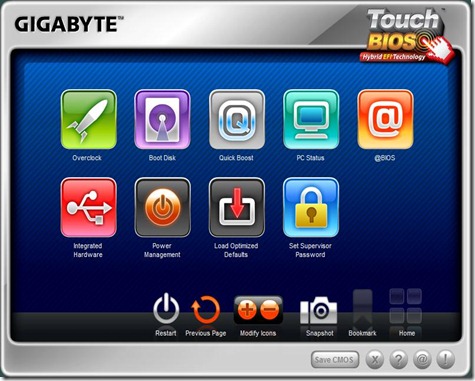
GIGABYTE Enables TouchBIOS on H61/P61 Platform


MAIN+4641_big (1)

Great news for H61/P61 users wanting to use TouchBIOS on their systems. In addition to the Z68 series, GIGABYTE has just updated several H61/P61 boards with the latest BIOS that will now enable support for our new icon-based BIOS. All you have to do is update to the latest BIOS listed and install the TouchBIOS application, both of which you can do by visiting the GIGABYTE website. Stay tuned in the next coming week or two, as GIGABYTE will also enable TouchBIOS on our AMD A75 and 900 series motherboards.

GIGABYTE H61/P61 Motherboards now Supporting TouchBIOS

Model

Version

BIOS

H61M-USB3-B3

1.1

F8D

H61M-D2-B3

1.1

F7C

H61M-S2V-B3

1.1

F5E

H61M-S2P-B3 (coming soon)

1.1

F2B

H61M-S2-B3

1.0

F2F

P61-USB3-B3

1.1

F8B

P61-DS3-B3

1.1

F3A

P61-S3-B3

1.0

F4A

What is TouchBIOS you ask? Take a look at the video below to find out.

<\/param><\/embed><\/object><\/div>";" alt="">

Thursday, 5 May 2011

Lucid's Virtu Enables Simultaneous Integrated/Discrete GPU on Sandy Bridge Platforms

We first met LucidLogix (now just Lucid) 2.5 years ago at IDF. The promise was vendor-agnostic multi-GPU setups with perfect performance scaling. The technology was announced at a very important time. Intel and NVIDIA were battling out support for SLI on Nehalem motherboards. NVIDIA didn't want SLI enabled on any non-NVIDIA chipsets, and Intel wasn't about to let NVIDIA build any chipsets for Nehalem. Lucid's Hydra technology seemed to be exactly what we needed to get around the legal holdup that kept Nehalem users from enjoying SLI.

Three things made Lucid's technology less interesting as time went on. Hydra took two years to come to market, NVIDIA enabled SLI on Intel platforms and single GPU performance got really, really good.

What made Lucid's Hydra tech possible was a software layer that intercepted OpenGL and DirectX calls from the CPU and directed them to a GPU of Lucid's choosing. While Hydra saw limited success, parts of the technology had another application.

Read on for our performance preview of Lucid's Virtu for Sandy Bridge platforms.

]]>

Monday, 17 January 2011

Lucid Enables Quick Sync with Discrete Graphics on Sandy Bridge

If you read our Sandy Bridge Review you’ll know that we were very excited about Intel’s Quick Sync hardware transcode engine. It easily offers at least twice the performance of existing GPU based transcoding solutions without sacrificing image quality. There’s just one little problem: you can’t use Quick Sync you're using a discrete GPU, you need to use Intel's processor graphics.

Lucid presented a potential solution to the problem at this year’s CES. Through software alone, Lucid is able to copy the frame buffer from a discrete PCIe GPU to the frame buffer of SNB’s HD Graphics in main memory. The result is that you can hook a single monitor up to your motherboard’s video output and use a discrete GPU when you want it. Lucid’s technology would enable switchable graphics on the desktop, without any hardware requirements (it still obviously won’t work on P67, shame on Intel).

To demonstrate the technology Intel ran an H67 motherboard with a GeForce GTX 480. Lucid’s software was installed which allowed for the GTX 480 to run and its frame buffer output to be copied to main memory and sent out via Intel’s Flexible Display Interface through the DVI port on the back of the motherboard. 

At the same time, Intel demonstrated that it could run a Quick Sync enabled transcode in Cyberlink’s Media Espresso 6 - all thanks to Lucid’s software.

Lucid expects that there will only be a 1 - 3% impact in performance (although that’s something we’d have to see for ourselves), but there’s no firm date on when the driver will be available. I’m expecting a beta version of Lucid’s software in the coming weeks however.

Motherboard manufacturers could bundle Lucid’s solution with their boards to avoid upsetting end users thanks to Intel’s Quick Sync oversight. There’s still no getting around the fact that you can’t overclock your CPU on H67 motherboards. You’ll still have to wait for Z68 to fix that problem.

]]>

TOP PRODUCTS

Related Posts Plugin for WordPress, Blogger...
Design by ROCKY| computer hardware by ROCKY